

edited by John Hayes
“You see them WITH glasses!”…
A Short History of 3D Movies
Part One: The 1800s to the 1950s
The 1800s
3D movies have actually been around a lot longer than widescreen ones. Almost as soon as the early still cameras were invented, it was realised that they could easily be adapted to produce a stereoscopic image. Indeed, as early as 1856, J. C. d’Almeida gave a demonstration at the Academie des Sciences in which two stereoscopic images (that is to say two views of the same scene, photographed from slightly differing points of view - usually around two and a half inches - representing the distance between a pair of human eyes) were projected in rapid succession as lantern slides coloured red and green, with the audience viewing the screen through spectacles fitted with red and green lenses (This system of rapidly alternating left and right eye views would be used again - but not for more than a hundred years! We’ll come to that later). The green image could only be seen through the red lens and the red image only through the green one, effectively sending two slightly different images of the same scene to the brain of the viewer, where they would be combined to form a three-dimensional image. Nevertheless, in spite of this remarkable discovery, for most people in the Victorian age their only experience of viewing 3D images would be via one or the other of the two most popular types of stereoscope in use at the time; the Holmes or the Brewster.
After a period of very little advancement in 3D projection, the 1890s produced a positive flurry of activity in the field, when Ducos du Hauron produced and patented a refinement of the two-colour, or anaglyph, system by superimposing a pair of transparent stereoscopic images, one coloured red and the other blue, on top of each other. When projected, the viewer would see a three dimensional scene through glasses having one blue and one red lens.
By the end of the century, moving pictures had arrived and 3D wasn’t very far behind. In 1897 a Mr. C. Grivolas adapted the anaglyph technique to movies by using a specially constructed camera that would expose two reels of film simultaneously, through two lenses spaced as far apart as human eyes. The resulting prints were then projected simultaneously on to the same screen by two interlinked projectors, with one lens having a red filter and the other a blue one. Once again, the audience would don red and blue lensed glasses only this time they would see a three dimensional moving picture - the effect must have been truly startling to Victorian eyes. And this would be almost exactly the way that 3D movies would be projected in the future.
The 1900s
As would continue to be the case with 3D movies right up to the present day, a few brief presentations here and there would be followed by very long periods during which no one would see, or even hear of 3D. Several more years passed until an anaglyphic presentation of random scenes shot in and around New York and New Jersey by Edwin S. Porter (maker of the very first motion picture feature, The Great Train Robbery) and William E. Waddell, took place at the Astor theatre in New York on June 10th 1915. An interesting novelty use of the anaglyph system was made in 1918, on the Keith-Abbey vaudeville circuit, which had nothing whatever to do with motion pictures. A troupe of high-kicking chorus girls went through their routine while a translucent screen was lowered in front of them. Lit from behind with red and green lights, their red and green shadows were cast on to the screen, which the audience then viewed through red and green glasses - giving the effect of the girls’ high kicks going right over their heads! And though it is generally accepted that other occasional 3D presentations were given, none of them are officially recorded until the 1920s, when several major attempts at re-launching 3D movies occurred, more or less at the same time.
The first of these was an anaglyph format presentation - and the World’s first 3D feature film - given by film maker and inventor Harry K. Fairall, entitled The Power of Love. It opened at the Ambassador Hotel Theatre in Los Angeles on September 27th 1922 - and the reviews were very favourable. A few months later, during the Christmas holidays, William Van Doren Kelley, inventor of the Prizmacolor process, presented his ‘Plasticon’ anaglyphic short film Movies of the Future. This was shown at the Rivoli theatre in New York City. Early in the following year, Kelley would show a second Plasticon short - a travelogue about Washington DC - also at the Rivoli. Kelley’s process used film coated on both sides, with the red image on one side and the green image on the reverse. The audience viewed the 3D image through spectacles that had a pair of red and green Cellophane lenses.
While all these systems were variations on the anaglyph stereoscopic method, a more radical idea came along with the presentation of the ‘Teleview’ system on December 27th at the Selwyn theatre in New York City. The inventors of the Teleview system, Laurens Hammond and William F. Cassidy, had decided to take a completely different approach to the presentation of 3D images by designing an extremely complex projection and viewing system (although an almost identical system had been demonstrated by C. Dupuis in Paris as far back as 1903) Their process required two reels of film to be exposed through lenses approximately 2 ½ inches apart. The two resulting prints were run simultaneously through two projectors that were electronically linked so that they would remain synchronised throughout the performance. One print, however, would always be one frame behind the other; this would effectively produce alternating left and right images on the screen. In order to make a stereoscopic image of the alternating pairs, each member of the audience would be seated behind his own ‘televiewer’ - the heart of the system. This was a mechanical viewing device, which contained a rotating shutter, driven by an electric motor running in synch with the projectors and turning at some 1500 rpm. The shutter would block the left eye view of the spectator when the right eye image was on the screen and vice versa. Contemporary reports indicate that the effect was quite good.
Unfortunately, the programme wasn’t quite so favourably received. It began with of a couple of shorts, one of which was a kind of travelogue featuring Hopi and Navajo Indians. These preceded the main feature, a space travel film called M.A.R.S. (also known as Mars Calling, The Man from Mars and Radio Mania), which was at that time only the second feature length 3D movie. The poor reviews coupled with the expense of installing the equipment more or less killed Teleview right there. But interestingly, the alternating frame system would be reborn more than sixty years later. It would be developed in Japan initially for home video use with LCD shutter glasses replacing the Televiewer, and subsequently adapted for use in IMAX theatres for their earlier 3D presentations (now abandoned in favour of less cumbersome polarised glasses). It would seem that the Televiewer was simply too far ahead of its time - but it does go to show that a good idea never really goes away.
Also in 1923 came an alleged 3D system that its developers dubbed ‘Natural Vision’ - not to be confused with the later, and completely different 1950s system, which would bear the same name. This first Natural Vision was the brainchild of George K. Spoor, co-founder of the Essenay Studio in Chicago, who had formed a new partnership with Paul J. Bergren in 1916, specifically to develop a new 3D system. Six years later, Natural Vision was demonstrated on August 23rd 1923, with an actual feature promised within ten weeks. Another six years - and two weeks - later, the first Natural Vision feature was unveiled. Danger Lights premiered at the State-Lake theatre, in Chicago - but not in 3D. Somewhere along the line, Spoor and Bergren had quietly dropped 3D in favour of the big screen, and Natural Vision became the name that RKO used for all their films that were shot on 63mm film.
But to return to anaglyphs, the most successful system of that period was undoubtedly the one developed by Frederick Eugene Ives and Jacob Leventhal. They had each been working separately to develop a 3D presentation system, and decided to pool their efforts, producing a series of shorts at a studio in Fort Lee, New Jersey. They called the first one Plastigrams, which was given a limited release by Educational Pictures towards the end of 1923 and into 1924. For some unknown reason, Educational decided not to pick up their option on the remaining four shorts, so they languished for nearly a year, until the Pathe Company began releasing them at eight-week intervals from the beginning of 1925. Collectively, they were known as Stereoscopiks, and their titles were: A Runaway Taxi, Zowie, Ouch and Lunacy.
Meanwhile, over in Europe, legendary filmmaker, Abel Gance was shooting his epic film, Napoleon, in the super-widescreen format that he had developed, called Polyvision. A forerunner of Cinerama, Gance’s system used three synchronous 35mm cameras to produce panoramic scenes that would be spread over three adjoining screens. Ever the pioneer, he decided that he would add 3D to certain scenes as well. Though there are no records of the methods he used to attain his 3D effects, it is obvious from his own comments on the process that it was a type of anaglyph system:
“To see the rushes, I had to wear those red and green spectacles. The 3D effects were very good, and very pronounced. I remember one scene where soldiers were waving their pistols in the air with excitement, and the pistols seemed to come right out into the audience.”
Unfortunately, Gance decided to abandon the stereoscopic segments, and indeed, even the three-panel system was used in only a few of the early European showings of the finished film.
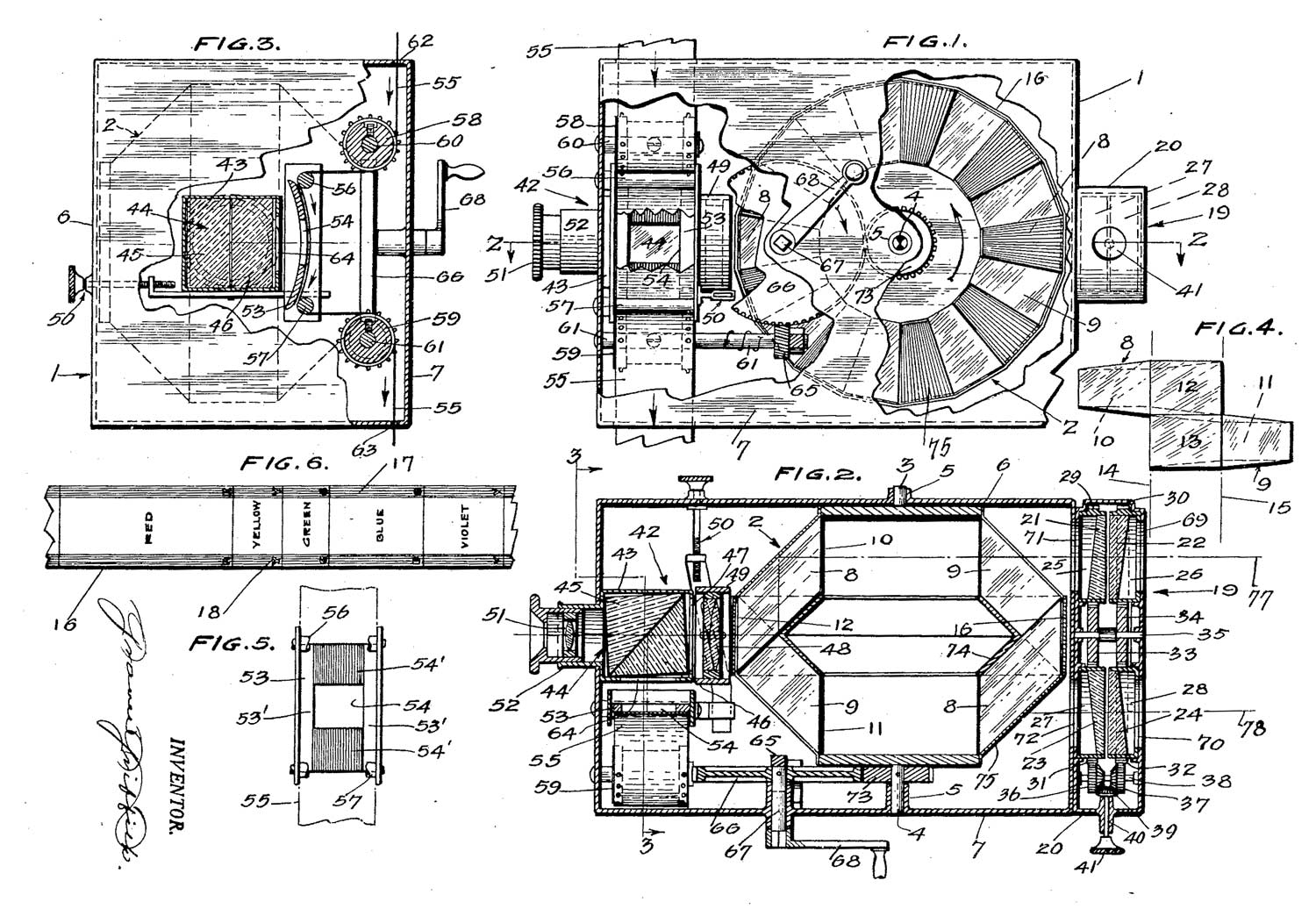
For the reminder of the 1920s, very little happened in the field of stereoscopic movie making. Technicians were experimenting with sound systems that would revolutionise the cinema industry in the coming years, and the World was sliding towards the depression era. In 1929, a San Francisco man by the name of Graves Griffith, developed a ‘stereoscopic colour cinematograph apparatus’, and was even granted a patent for it.
Widescreen Movie Magazine has recently received an email from Graves Griffith's great-grandson, Tom Bedecarre, who kindly provided a link to the patent:
US Patent 1,705,760 - Stereoscopic Color Cinematographic Apparatus - Issued Mar. 19, 1929
Click the image for a larger view; the full text |
Graves Griffith had several other related patents:
US Patent 1,334,532 - Optical Device for the Production and Projection of Stereoscopic Pictures - Issued Mar. 23, 1920
US Patent 1,513,984 - Optical Instrument for Taking and Projecting Pictures - Issued Nov. 1924
US Patent 1,556,216 - Photographing and Projecting Instrument - Issued Oct. 6, 1925
US Patent 1,819,327 - Means for the Elimination of Distortion and the Creation of Stereoscopic Effects in Moving Pictures - Issued Aug. 18, 1931
The 1930s and the 1940s
But the most interesting breakthrough did not come until 1932, when Edwin H. Land was granted a patent for ‘Polaroid’ filters.
Land’s cheap and simple method for producing polarising filters, as described by Brian Coe in his excellent book, The History of Movie Photography, involved depositing crystals of a chemical called Herapathite as a thin film, which was then manipulated in order to align these needle-like crystals in one direction. This had the effect of creating a microscopic grill, through which would pass only those undulating light waves that were similarly aligned. And because Land’s filters worked on the principle of selecting the orientation of light waves rather than blocking certain colours (an almost identical process had been developed in Europe by the optical company, Zeiss-Ikon), it would be possible to produce full-colour 3D images - if only there was such a thing as full colour film! Happily, this was not too far away, as full-colour film would become available in1935.
The arrival of these new filters had a stimulating effect on the 3D film making community in various parts of the world, and it wasn’t very long before the first colour presentation of polarised 3D projection was given, in June 1936 at the Haus der Technik, in Berlin. The pairs of stereoscopic images were printed side by side on a single strip of film and projected on to a metallic coated screen (a metallic screen preserves the directional integrity of light waves when they reflect back to the audience; something that doesn’t happen with a conventional white screen) through a pair of Zeiss polarising filters. The film was called Zum Greifen Nah -You Can Nearly Touch It -, and it was shot in a fairground on two-colour Agfa film stock. The film was shown to the public the following year on 12th December 1937 at the Ufa Palast am Zoo in Berlin. A second production followed in 1939, using an improved system that utilised horizontally running film. This film was called Sechs Madel Rollen in Wochenland.
It’s also worth noting that You Can nearly Touch It may have been slightly pre-empted by an Italian production, shot using polarising filters, Nozze Vagabonde - Beggar’s Wedding, which was also shown in 1936, though not in colour.
Meanwhile, back in the USA, the previously mentioned partnership of Frederick Ives and Jacob Leventhal had been dissolved, Leventhal then teaming up with another accomplished 3D experimenter, John Norling. Together, they devised a system using a pair of Bell and Howell cameras in a face-to-face configuration, shooting into angled mirrors. They made an assortment of 3D shorts that were eventually sold to MGM. Unsure of what to do with them, they were handed over to their ‘shorts’ specialist, Pete Smith, who was able to assemble them into longer ‘short’, which was released on 11th January 1936 - in anaglyph format - under the title of Audioscopiks.
Leventhal and Norling continued to produce more of their short 3D films, which were subsequently released on 15th January 1938, under the title The New Audioscopiks.
The following year, Norling, in collaboration with the Polaroid Corporation, made a fifteen-minute 3D short for the Chrysler Motors Exhibit at the New York Word’s Fair. Depicting the assembly of a Plymouth motorcar, the film ran from the 4th may 1939, and though it was shot in black and white, it was considered the largest scale presentation of 3D to that date, as more than 1,500,000 people saw it. Norling remade the film in colour for Chrysler for the 1940 World’s Fair. It was now called New Dimensions, but this time it was filmed using Technicolor 3-strip cameras. Norling also produced a third 3D short, Thrills For You, for the Pennsylvania Railroad exhibit at the Golden Gate Exposition of 1940 in San Francisco which was shot in black and white. MGM, having been satisfied with the reasonable success of their Audioscopiks, instructed Pete Smith to produce one of his own. Released on 1st march 1941, Third Dimension Murder was a spoof on the popular ‘Frankenstein’ movies; but WWII was rapidly approaching and would bring production of 3D movies to a virtual standstill.
Whilst all this was happening in Europe and America, The Russians had quietly been experimenting with various 3D systems, from alternating frame, through anaglyph up to and including polarised 3D. But in the end they decided to explore a completely different route by attempting to perfect a method of 3D presentation that did not require the audience to wear glasses at all: the parallax stereogram.
This method of stereo photography had first been demonstrated in the early part of the century by A. Berthier, E. Estenave and our friend Frederick Ives, but by the early 1930s had been perfected by Russian engineer Semyon Pavlovich Ivanov. A parallax stereogram is produced by placing a screen, usually made up of fine wires, in front of a sensitive photographic surface, in such a way that parts of the surface are shielded from the left eye lens and other parts from the right eye lens. When exposed, this will produce a double image made up of interlaced left and right eye views of a scene. The printed photograph is then viewed through a similar screen which will allow each of the viewer’s eyes to see only the appropriate left or right eye parts of the image. The wire viewing screens were later replaced by plastic screens made up of fine lines which could be laminated directly on to a parallax stereogram, each line, in effect, acting as a tiny lens directing the eyes to their appropriate view. This type of stereoscopic process, which does not require viewing glasses and permits simultaneous viewing by any number of persons, is still used today, usually in the production of novelty 3D items such as 3D bubblegum cards, 3D postcards and even 3D posters.
Ivanov then went on to adapt the principle for use in motion pictures. In his book Stereoscopy, Russian stereographer Nikolai Valyus, describes in great detail the incredibly complex and cumbersome equipment that becomes necessary when the principle of the parallax stereogram is applied to the projection of moving stereoscopic images; but a more concise description can be found in Brian Coe’s previously mentioned 1981 book, The History of Movie Photography:
Ivanov adapted this idea for the cinema. His first patent was filed in 1935 and using a glass grating he demonstrated his process in 1937. In 1940 he replaced the glass grating with a fine wire screen. The system was installed in the Moskva cinema in Moscow in 1941; 112 miles of wire were used to make a grid over a screen of about 14 x 19 feet. The films were shot with a conventional camera with a beam-splitting device on the lens, producing two vertical format pictures side by side in the standard film area. The soundtrack ran between the two pictures on the print. The film was back-projected, with a grid on the projector side of the screen to divide the two pictures into interlaced line images. A similar grid on the audience side created the correct viewing conditions for 200 seats laid out in a fan-shaped area. This was necessary for in some places in the auditorium no true stereoscopic image was presented.
The Russians produced two films for this system in 1940, the first being Concerto, which premiered at the Moskva cinema on the 4th February 1941, and the second, entitled Day off in Moscow, which continued there until the cinema was closed in June of 1941 because of WWII
Coe goes on to explain that the wire screen was eventually replaced by a lenticular ribbed glass screen and the vertical format images changed to square by reducing the size of the sprocket holes on the film. In February of 1947 a film entitled Robinson Crusoe was shown on a 5 metre square screen at the Vostock Cinema in Moscow, and the Russians went on to produce several more 3D movies prior to the 1950s: Pal; The Pencil on the Ice; Precious Gift; Lalim; May Night; Crystal and Aleko.
By 1952 the format had changed again and the screen assumed the normal 1.33:1 ratio, with the image pairs recorded on the film one above the other by means of a prism attachment on the lens. By 1955 there were 12 cinemas of this type in the USSR, and though the system worked quite well, it required the audience to avoid unnecessary sideways movement of their heads as this would dispel the stereoscopic effect.
The parallax stereogram system was not taken up outside the USSR apart from one variation on the idea, called the Cyclostereoscope, that was demonstrated at the Luna Park, Paris in 1949, in which the grid screen was rotated rapidly in an attempt to remove the vertical line effect.
Before we leave the 1940s, there was one more development in 3D photography that was extremely interesting and is well worth mentioning, even though it was never made available commercially. This was the Polaroid Vectograph, developed by Edwin Land’s Polaroid Corporation. It would seem that the Vectograph process had succeeded in solving every one of the problems associated with stereoscopic projection. It used only one strip of film; it used the whole area of the frame, giving a clearer, brighter image, and did not require polarizing filters, mirrors or prisms to be attached to the projector. In addition, the film was practically grainless. With ordinary film, the image is made up of various densities of a chemical called silver halide, whereas a Vectograph image is comprised of varying degrees of polarization. The film is double-coated so that the left image can be placed on one side of the film and the right image on the reverse, meaning an end to the synching problems that plagued dual strip 3D presentation. The film itself was a polarizing filter, so only the audience required polarized glasses to view the stereoscopic images on the screen. These images were laid on the film using a dye transfer system similar to the old Technicolor process. A monochrome version had been developed for the US Navy during WWII, and Land, at the behest of Warner Brothers, eventually developed a full colour version - unfortunately by that time, the end was in sight for 3D movies and Warners had lost interest in 3D production and a very frustrated Dr. Land was left with no market for his invention.
The 1950s - The first 3D boom
Outside of the Soviet Union, the immediate Post-War world saw little progress in the field of 3D movies, although a 3D newsreel was produced in Holland in 1948. Photographed in colour, Queen Juliana was shot using a Dutch system known as Veri-Vision; a single camera, single film process that incorporated full and half-silvered mirrors to obtain the the stereo images (not unlike a commercially available stereo attachment for camcorders that is available today). Though considered a success at the time, Veri-Vision had considerable limitations, and in fact, violated several laws of 3D presentation.
By the end of the 1940s, the film industry was in trouble. Cinema attendances were at an all-time low and theatres were beginning to close at an alarming rate. Returning servicemen were settling down and starting families, and somehow going to the movies had slipped down the list of priorities as their new responsibilities began to take hold and they looked for other, more family-orientated pursuits - and the one pursuit that seemed to be rapidly gaining the most popularity was watching television.
As studio executives contemplated their rapidly dwindling audiences - and therefore bank balances - help was on hand. Although they didn’t know it yet, TWO lifelines were about to be thrown to them, almost simultaneously
As we have detailed in an earlier article, Fred Waller was on the verge of adapting his amazingly efficient and successful gunnery trainer into a workable, ultra widescreen cinema system that would almost literally surround an audience with pictures and sound - Cinerama. Within the next couple of years, the lost cinema audiences would be back, queuing around the block to see the first film in his process, This is Cinerama. Almost immediately - and very characteristically - the studios began to search for cheaper, less complex means of reproducing the same effect and though they never really succeeded, it did change the way movies were presented forever.
And then came the second lifeline - from England this time.
In 1948, planning began for the Festival of Britain, an event that was conceived by the then Labour Government’s Deputy leader, Herbert Morrison and composer Gerald Barry. It’s purpose was to demonstrate to the war weary population of the British Isles - and the whole World, for that matter - that Britain was on the road to recovery after the ravages of the war years; it would showcase developments in the Arts, Sciences and Design Technology and would, in the words of Morrison himself, be “A tonic for the Nation”.
Two brothers, Raymond and Nigel Spottiswoode, highly regarded in the field of film making and experimentation, were commissioned to design and build a cinema of the future. In the short space of 14 months, they created what was to be called the Telecinema and produced five 3D shorts to be shown therein, two of which were cartoons created by noted Canadian animator Norman McLaren: Around is Around and Now is the time...to put on your glasses. The system used to photograph these films was designed and constructed by Leslie P. Dudley and consisted of two Newman Sinclair cameras mounted ‘face to face’ with angled mirrors placed in front of each lens in order to deflect the image of the scene being shot into each camera.
Stereophonic sound would be added later, for showing in the Telecinema - which could indeed be described as the cinema of the future as it included, apart from stereo sound facilities, its own lenticular screen for 3D without glasses and newly designed equipment for TV projection. It proved to be tremendous success at the Festival of Britain, attracting long queues for each performance.
The Spottiswoode brothers then formed a company called Stereo Techniques Ltd and began to produce several more short films. Some of these were released in the USA by film producer Sol Lesser, famous for his low-budget westerns and Tarzan pictures. These shorts stimulated tremendous interest in 3D once again. A cameraman named Friend Baker, who had been granted a patent for a 16mm single strip 3D process, was approached by brothers Milton and Julian Gunzeburg to design a 35mm 3D rig. The finished result - with the help of O.S. Brhyn and Lothrop Worth - was almost identical to to the one Leslie P. Dudley had produced in England, except that the cameras were replaced by Mitchell NCs and a heavy sound blimp was added. They then formed a company to promote their rig: The Natural Vision Corporation.
The Gunzeburgs failed to make any headway with the Hollywood executives, most of whom were extremely wary of investing time - and more importantly, money - in what they considered to be little more than a fairground exhibit. Both Columbia and Paramount passed on the system and Fox were by this time involved in developing their CinemaScope process, and had no time for any other system. MGM took out an option on Natural Vision after being persuaded to do so by John Arnold, head of their camera department, but soon allowed it to lapse. But then, as luck would have it, radio writer turned filmmaker Arch Oboler was immediately struck by the possibilities of the Natural Vision system, agreed to step in where the studios were afraid to tread. With his producing partner, Sidney Pink, they scrapped the ten days of conventional 2D - or ‘flat’ footage - that they had already shot of their feature production, The Lions of Gulu, and started from scratch using the Natural Vision rig.
Retitled Bwana Devil, the film is based on true events which took place at the Tsavo River crossing, Kenya in 1898 during the the building, by the British, of the Uganda Railway, during which 140 workers were killed by lions (the same event was also the basis for the 1996 film The Ghost and the Darkness, which starred Michael Douglas and Val Kilmer). It starred Robert Stack, Barbara Britton and Nigel Bruce and was shot on location, not in Africa, but at the Paramount Ranch in California’s Santa Monica Mountains. The area is now part of a National Recreation Centre and still has a ‘Bwana Trail’ to mark the locations used in the film. To add a little authenticity to the backgrounds, Oboler incorporated some genuine African 2D footage that he’d shot in 1948. Anscocolor film was used in the Mitchell camera rig instead of trying to adapt the cumbersome 3-strip Technicolor cameras to Natural Vision.
Bwana Devil opened on 26th November 1952 at Paramount Theatres in Hollywood and Los Angeles and was a tremendous success. Presented in dual strip format, utilising interlocked projectors and polarising filters, Bwana Devil is considered to be the first colour 3D feature film presentation. Further openings of the hit film followed in San Francisco on December 13th, with Philadelphia, Houston, Dallas and San Antonio on Christmas day and New York on February 18th 1953. Originally billed as ‘An Arch Oboler Production’ , United Artists paid $500,000 for the rights and began releasing it as ‘A United Artists Film’ from March 1953.
Hollywood was forced to sit up and take notice and there began an immediate scramble by the studios to replicate the success of Bwana Devil - preferably with 3D systems of their own. A man named Raphael Wolfe brought the Stereo Techniques system to the USA, rebuilding the rig and replacing the Newman-Sinclair cameras with Eclairs, but with little success, if any. Columbia were quickest off the mark with their own hastily assembled rig, and had rushed into 3D production a noirish crime thriller, Man in the Dark (1953), starring Edmond O’Brien and Audrey Totter. The first ‘official’ studio release of a 3D feature (Bwana Devil was an ‘Independent’) it tells the story of a bank robber who undergoes surgery, while in prison, which is meant to eradicate his criminal tendencies. It also makes him lose his memory - inconveniently including where he stashed the loot. He is then kidnapped by his former cronies who naturally attempt to beat the location out of him. His memory returns in a series of weird dreams, and the film climaxes in a chase over a roller coaster. Shot in monochrome, it was released in something called ‘sepia Mono-Color’, opening on 9th April 1953.
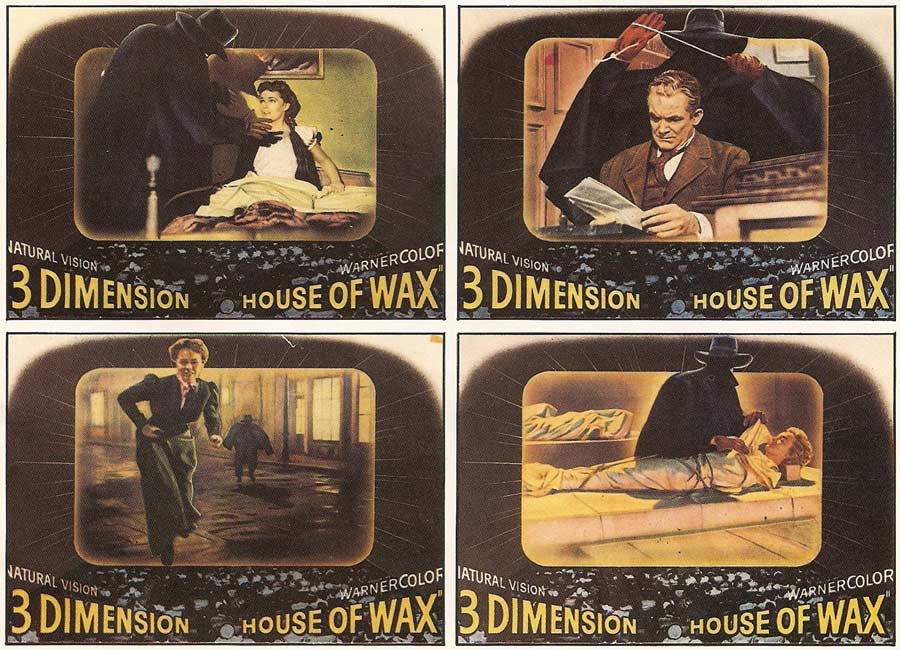
But probably the biggest breakthrough was made by Warner Brothers. They had begun shooting a 3D movie on January 19th 1953, using the blimped Natural Vision rig. Originally called The Wax Works, the title was changed prior to its completion on February 20th to House of Wax. Starring Vincent Price, Phyllis Kirk, Carolyn Jones and Frank Lovejoy - with a supporting role from a certain Charles Buchinsky, who would go on to super stardom under the name of Charles Bronson. A remake of Warner’s earlier production of Mystery of the Wax Museum (1933), it tells the story of a talented waxworks sculptor, Henry Jarrod (Price) who is double crossed by his duplicitous partner, Mathew Burke (Roy Roberts) and is apparently killed when the wax museum they jointly own is deliberately burned down by the crooked partner, who then collects the insurance. Burke is subsequently murdered by a mysterious, disfigured character, and a new waxwork show appears. However, the beautifully sculptured figures are moulded over the bodies of murder victims...
An original set of House of Wax Lobby cards |
 |

House of Wax was an instant hit when it premiered in New York on 10th April 1953, and deservedly so; it is still a hugely entertaining film when seen today, more than fifty years later, even in a flat version. But at the time, the sumptuous colour and superb 3D photography and six-track stereophonic sound were a revelation - the latter all the more remarkable because the director, Andre de Toth, was blind in one eye therefore and had no stereoscopic perception. Presented in an aspect ratio of 1.37:1, it remained the highest grossing 3D movie until 1969's The Stewardesses, a low-budget sexploitation flick.
3D was up and running now and the studios began an almost mad scramble to acquire 3D rigs of their own and get a 3D movie into production. Columbia bounced back first, on 1st May 1953, with Fort Ti, an excellent action adventure story set against a backdrop of the French and Indian Wars in Colonial America, which starred George Montgomery. For Fort Ti, they abandoned their first camera rig in favour of Natural Vision, and enjoyed much success with this movie which, incidentally, was directed by the indomitable William Castle, who would later become more renowned as the creator of gimmick-laden horror movies such as The Tingler (1959), 13 Ghosts (1960) and The House on Haunted Hill (1959) than for the many other genres he worked in during his long and successful career.
3D at the London |
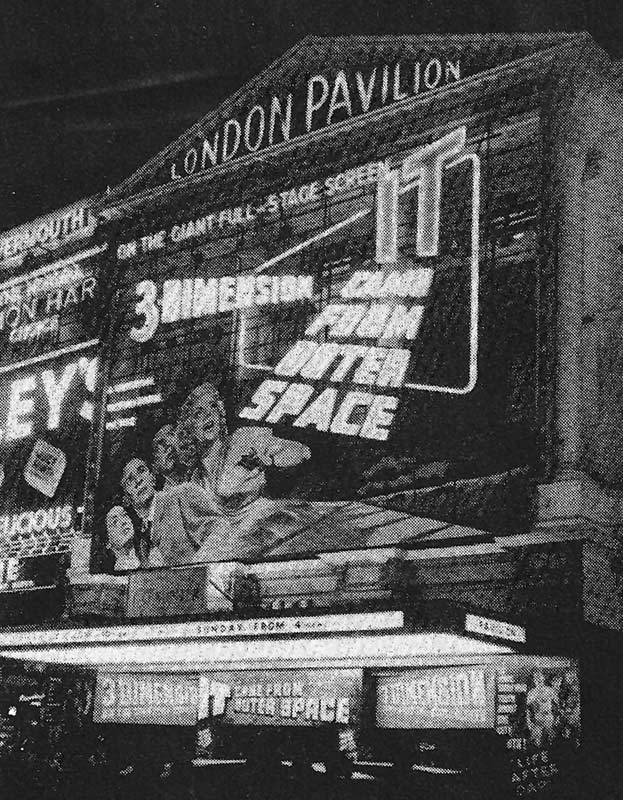
In the midst of the rush into 3D film production, Universal International were a little more cautious than most, taking great care with the designing and testing of their own camera rig. The result was worth waiting for; on 25th May they released one of the finest of the 3D movies that would be produced in the 1950s, It Came From Outer Space. Directed by Jack Arnold and starring Richard Carlson, Barbara Rush and Charles Drake, this aliens-take-over-a-small-town sci-fi classic contains some of the very best stereoscopic compositions ever put on film.
Even Disney were not immune to the 3D bug - though Walt would only go as far as producing a couple of short cartoons, Melody and Working for Peanuts, and somewhat half-heartedly, a Mickey Mouse Club special that was called exactly that: The Mickey Mouse Club Special.
Over at Paramount, Adolf Zukor had slammed the brakes on a film that had already started shooting, and had them start over in 3D, releasing Sangaree on 27th May, with only moderate success in spite of the pairing of Fernando Lamas and Arlene Dahl.
MGM’s first offering was a mediocre rodeo movie, Arena starring Gig Young and Jean Hagen; but later in the year (1953), they would produce another 3D movie, their last in 3D, that would find itself among the best remembered musicals of all time, the wonderful Kiss Me Kate, with Howard Keel and Kathryn Grayson. - a film that was designed beautifully for 3D.
20th Century-Fox, fully committed to their new CinemaScope system, took an extremely wary view of 3D and studio chief Darryl F. Zanuck claimed to be singularly unimpressed by the other studios’ 3D efforts so far; Fox even promoted CinemaScope with the tagline,“You see it without glasses!” However, with great reluctance, he caved in to the perceived demand for 3D and Fox released Inferno on August 12th 1953. A very good western by any standards, and starring Robert Ryan and Rhonda Fleming, Inferno provided disappointing box 0ffice returns for the studio, in spite of its superior 3D content. In May of the following year, Fox released their second - and last - 3D movie, Gorilla at Large - a much better film than its title might indicate, with a good cast that included Cameron Mitchell, Anne Bancroft and Lee J. Cobb; good production values and beautifully filmed in Technicolor and like Inferno, shot with Fox’s own Clear-Vision 3D rig. These were the only Fox 3D movies released during this period - and Gorilla was only released by Fox, having been made by Panoramic Productions; but the studio would revisit 3D briefly in the next decade with the 1960 3D movie September Storm.
All the major studios had 3D movies in production by this time, and the next couple of years saw the release of some really good 3D pictures, many of which attracted the talents of the period’s ‘A’ list stars - John Wayne in Warner/Batjac’s Hondo (27th November 1953) - and supposedly his personal favourite of his films; Warner’s also released The Charge at Feather River on 11th July 1953, that most entertaining of westerns in which everything - arrows, spears, horses and people are happily tossed into the audience - a stream of tobacco juice as Frank Lovejoy spits at a rattlesnake; RKO’s Second Chance (1953) with Robert Mitchum, Jack Palance and Linda Darnell; the same studio’s The French Line (1954) with Jane Russell and Gilbert Roland; Columbia’s Gun Fury (1953) with Rock Hudson and Donna Reed along with their classic 3D movie Miss Sadie Thompson (1953) - “Rita Hayworth turns it on in 3D!”, ran the tagline; Paramount had favourites Dean Martin and Jerry Lewis in Money From Home in 1954; and Warner’s even persuaded Alfred Hitchcock to take up the polarizing spectacles in one of the best 3D films ever made, Dial M for Murder, in 1954.
It has long been a myth that the end of the 50s 3D boom was caused by poor quality films shot in 3D just to cash in on the current craze (unlike many of the 70s and 80s 3D movies yet to come). And while it may be true that few of them were in any danger of winning an Oscar, many have endured over the years to become classics, even in their flat versions - add to the above brief list Universal International’s Creature from the Black Lagoon (1954) and Revenge of the Creature (1955) - one of the last 3D movies of the period. Even the worst of them, Astor’s Robot Monster (1953) has attained a cult following despite it’s utterly awesome stupidity - most likely because of it.
And there weren’t just the 3D movies - there were 3D comics, too. Practically every comic publisher in the western world brought out a 3D version of one of their popular characters. There were 3D giveaways and gimmicks of all kinds. The ViewMaster reels were at the height of their popularity, and amateur Stereo Photography also boomed, with nearly every camera manufacturer bringing out one 3D model after another. It must have seemed at that time that 3D was here to stay for ever. Unfortunately, nothing does last forever; and in the case of the 3D movie craze - even as it boomed - the seeds of its destruction were already being sown.
Decline and Fall...
But even though the studios had thrown their support behind 3D movies, some flies began to land in the ointment. The first one (in the USA) was the rental deal that was forced onto the exhibitors by the distributors. Dual strip projection meant that, effectively, two prints of a 3D movie were supplied to the theatres - a left eye print and a right eye one. The distributors figured: two prints, twice the rental. The exhibitors soon discovered, though, that customers wouldn’t pay twice as much to see a 3D movie, especially because sometimes - and this led directly to the second big problem - you sometimes got sore eyes after half an hour watching a 3D picture! This was because some projectionists were more than a little casual when it came to 3D presentation. If one projector is slightly out of focus, or out of rack, the result is eye strain for the audience [see the accompanying article by Gary de Wan] as their eyes try in vain to correct the discrepancy. Occasionally, damaged frames would be removed and the ends of the film simply spliced together, instead of being replaced with the appropriate length of blank film, thus rendering the remainder of the film from that splice onwards, out of sync with the other. More eye strain! And while the exhibitors’ financial grievance was eventually resolved, some patrons eventually began to avoid a 3D presentation of a movie if they could see it flat somewhere else because they didn’t like having to wear the cardboard glasses. In fact, many theatres were booking single prints of 3D movies anyway (which were still marked ‘left’ or ‘right’) because they didn’t think 3D was worth all the effort and installation expense.
Here’s an example from my own experience. In Heywood, the small Lancashire town where I grew up, there were four cinemas in 1953, none of which were equipped to show dual strip 3D films. I know we had to go to the Scala in nearby Bury to see The Charge at Feather River, starring Guy Madison - I’d be around six years old at the time - but then I don’t remember ever seeing another 3D picture during that period, so they were probably a little thin on the ground in our part of the world, even at the height of the 3D boom.
The production of 3D movies began to peter out as the studios turned to the less troublesome CinemaScope as a means of coaxing the audiences back into the cinemas. By 1955 3D was finished and the wide screen was king. The studios had their research and development departments busily trying to find ways around Fox’s patented anamorphic system and thus avoid paying their exorbitant licence fee, which eventually they did. And of course, Mike Todd’s ‘Cinerama out of one hole’ Todd-AO was only months away.
3D might have been down, but it was not quite out. Several years later 3D would return - this time in widescreen, too! And some years after that a system called IMAX would be born; and when IMAX would eventually be combined with 3D we would be treated to 3D presentations that could only be described with one word: Awesome!
 |
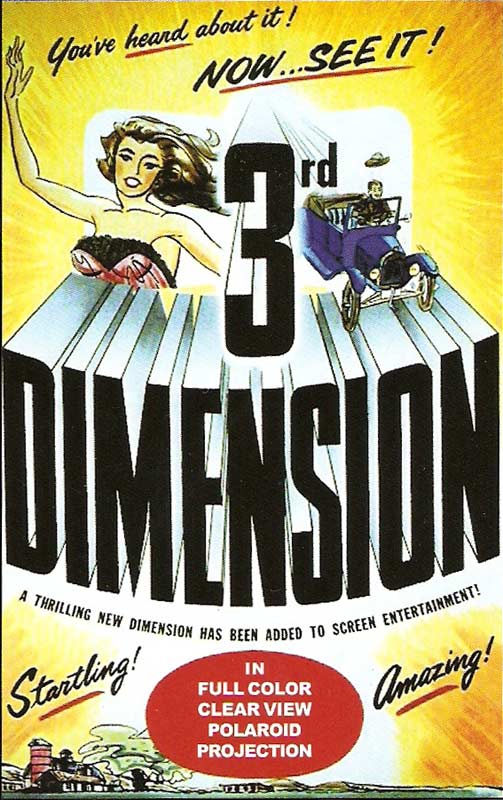 |
“You STILL see them with glasses!”…
A Short History of 3D Movies
Conclusion
The 1960s and 70s
The latter half of the 1950s saw the virtual disappearance of 3D movies from the World’s cinema screens, although one might surface occasionally for a brief showing – invariably an anaglyph print - only to return quietly once more to the depths, with scarcely a ripple left behind. 3D was effectively dead.
Gone, but not forgotten, though, and 3D made a cautious return to American cinemas, with the release of September Storm – appropriately on September 9th 1960 – an Alco Production released through 20th Century-Fox, and utilising a dual camera rig equipped with CinemaScope lenses that was dubbed ‘StereoVision’. Produced by Edward L. Alperson and directed by Byron Haskin, September Storm had an underwater treasure hunt type of plot and starred Mark Stevens and Joanne Dru. Although shot on location in Spain’s Balearic Islands, and despite the involvement of a major studio like 20th Century-Fox, the film performed poorly at the box office, amidst complaints of shoddy production values, grainy photography, chaotic editing and a rotten script (none of which can be confirmed by this writer, I should add). As if that wasn’t enough, there were also technical problems that arose on projection. Even the two 3D shorts that went out with it, Charito and Ernesto and Space Attack, couldn’t save the show. Just for the record, Alco’s only other production was the Roger Corman directed feature I, Mobster (1958), also in ‘Scope – but not 3D.
The following year saw the release of a Canadian-made feature The Mask (1961 – UK title Eyes of Hell), a black and white horror movie that contained several short anaglyphic sequences. The story involves a psychiatrist who is driven to the point of madness by his experiments with an Aztec mask, which can reveal the horrors of another dimension to the wearer. Unable to resist the disembodied voice which instructs him to “put on the mask”, the psychiatrist is plunged into this horrific netherworld, along with the audience, who have been previously instructed to put on their red and green glasses when they hear the voice. The Mask wasn’t a brilliant film by any means (and wasn’t actually released in the UK until the early seventies, where I saw it at the Rialto Cinema in Salford – it’s a McDonald’s, now), but this writer can confirm that the anaglyphic sequences weren’t bad at all and the whole thing was great fun.
U.K. poster for The Mask |
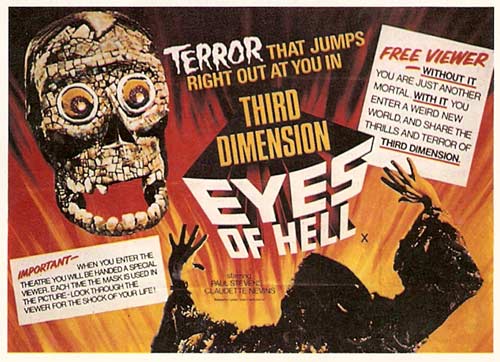
Unfortunately – or not, depending on your taste in movies – most of the 3D or part-3D productions of this period were of the sexploitation type. Titles like Adam and Six Eves (1962), The Bellboy and the Playgirls (1962 – and directed by newcomer Francis Ford Coppola) and Paradiso (another 1962 release – seems like this was a good year for the sex film industry) might give you a clue as to their content. And while they may have turned a modest profit for their makers, they did nothing to advance 3D technology. But in 1966 that would all change, thanks to an ex-army engineer and photographic expert, Colonel Robert V. Bernier, and his system called…
SpaceVision
Col. Bernier began his military service with the 29th Engineers, based in Portland, Oregon, where, as an already accomplished stereo photographer, he began to develop various systems to improve existing stereoscopic map making techniques – some of which had been in use since as far back as 1914. After service oversees, he was posted to Wright Field in Dayton, Ohio, where the Army Air Corps maintained their research and development laboratories. Here, he created the Stereoscopic Photographic Department, which undertook research and development of stereoscopic systems for aerial and medical use. Convinced that stereoscopic films would be useful in training military personnel, Bernier developed a system whereby the left and right images from a dual projector rig were printed on a single strip of film, one above the other. The two images would be superimposed on the screen utilising a prism device, which also incorporated polarising filters. After leaving the military, he continued to develop this system, in spite of the fact that the 50s 3D boom was drawing to a close, which meant that studio financing was no longer forthcoming. In the mid sixties, Bernier approached Arch Oboler – of Bwana Devil fame – who was at that time trying to develop another 3D project. With backing from Oboler, Bernier was able to develop what would become the heart of the SpaceVision system, the Trioptiscope lens. This device enabled the stacking of left and right images, one above the other, on a single strip of 35mm film, to take place in the camera at the time of shooting, thus dispensing with the dual camera rig – the first commercially viable system to do so.
The Bubble, which premiered on December 21st 1966, was the result of their collaboration. This was a, sometimes, baffling and overlong science fiction film in which a small American town, and its inhabitants, are imprisoned by aliens inside, well, a bubble (see issue 10 for Stuart Heal’s comprehensive review). In spite of some clever off-the-screen effects, The Bubble failed to impress audiences and was withdrawn soon after its release. Reissued several years later under the title The Fantastic Invasion of Planet Earth, it fared little better.
While the first film that Oboler made with Bernier’s system may have had little impact, the SpaceVision system itself drew quite a lot of interest within the stereo movie community, and before very long there were several variations of Bernier’s method circulating: the StereoScope system for example; or 3 Deepix from the Marks Polarized Corporation and Dan Symmes’ Dimension 3 System, to name three of the more successful ones - catchy system names were the order of the day, as in the wake of Cinerama and CinemaScope: Deep Vision; Optovision; Depth-O-Vision and…Cosmovision!!!
Bernier’s patented trioptiscope lens was, in fact, an attachment, which was fitted to a standard 35mm camera – in this case a Mitchell – in front of the normal spherical lens or lenses. The prisms inside the attachment placed a left and right eye view of a scene, one above the other within a standard four-perf frame (see illustration), which, when allowing for the optical soundtrack, produced two images, each two perforations high and with a 2.35:1 aspect ratio. Technicolor’s non-3D Techniscope system exposes a similar two-perf frame by moving the film through the camera two perfs at a time. In printing, the image is then stretched vertically to a four-perf height, making the resulting print compatible with anamorphic CinemaScope. The SpaceVision system prints the frames without any vertical stretch, necessitating the placing of a prismatic device in front of the projector to deflect the stacked images, converging them so they are superimposed on the screen. Polarizing filters are built into the device, and the audience gets to wear polarized glasses once again.
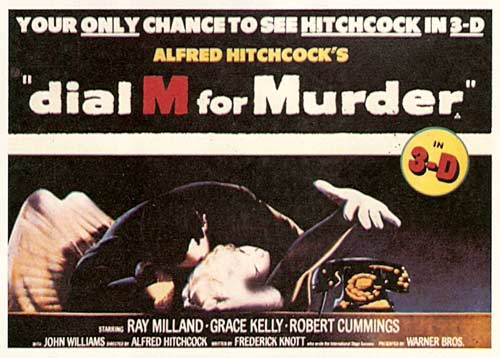 |
Other systems took a different approach. Stereovision, for example, used a 3-perforation pulldown on 65mm stock, placing the two images side by side. A 70mm direct contact release print can be produced from the negative for 70mm presentation, or a 4-perf, 35mm reduction print – with a 2x anamorphic squeeze added – for 35mm presentation. An alternative 35mm presentation was offered by printing the two images in the over and under system, all producing an aspect ratio of 1.85:1. Stereovision has been used for single strip reissues of dual strip classics such as Dial M for Murder and House of Wax.
House of Wax Reissue poster |
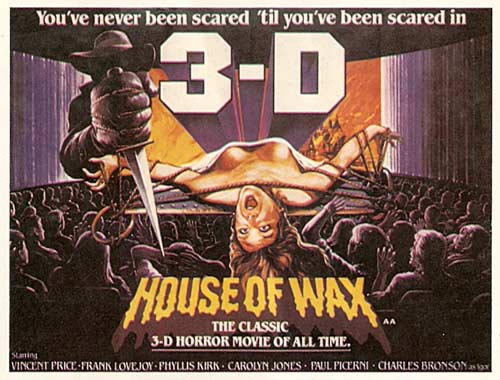
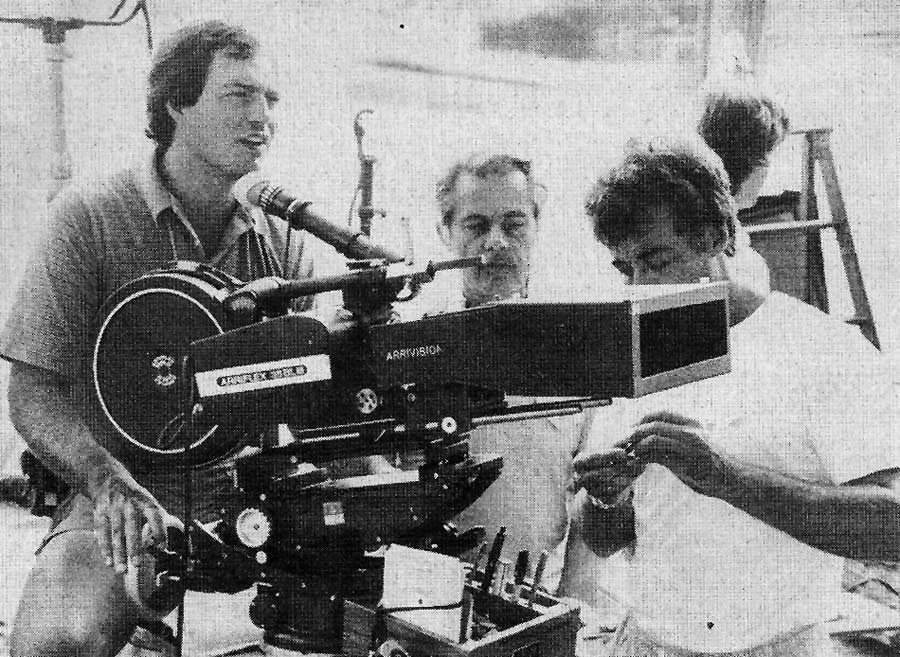
It was not until the 1980s that the various 3D systems would get to show what they could do, with the first half of the decade witnessing a mini 3D revival. Comin’ at Ya! (Optimax III, 1981) was quickly followed by Rottweiler: Dogs of Hell (Future Dimensions, 1982); Friday the 13th Part 3 (3Depix, 1982); Parasite (StereoVision, 1982); Spacehunter: Adventures in the Forbidden Zone (McNabb 3D, 1983); Jaws 3D (Arrivision, 1983 – and of which star Michael Caine said: “It was a terrible film – but the house that it paid for was beautiful”.); Metalstorm: The Destruction of Jared Syn (StereoVision, 1983); Amityville 3D (Arrivision, 1983); Treasure of the Four Crowns (3Depix, 1983). In 1985, the first animated feature length 3D cartoon appeared, Starchaser: The Legend of Orin. A South Korea/US production, Starchaser consisted of conventional hand-drawn animation over computer generated frames. This Star Wars-inspired tale combined excellent animation with surprisingly good 3D.
Stereovision was rejected for filming |
All of these systems, however, had the same irritating drawback: they were all designed to be 2.35:1 single strip systems, and a single strip of film projected through a polarizing filter and being viewed through another – the glasses – means huge light loss and a much dimmer picture. Another problem, particular to 35mm presentations, becomes apparent when the fact that the tiny, 2-perf high frames are enlarged to fill a commercial cinema screen that may be thirty feet wide or more, resulting in further degradation of the image.
65/70mm 3D and IMAX – and the Digital future…?
This fact was not lost on Dr. Richard Vetter, the co-designer, with colleague Carl W. Williams, of the excellent Dimension 150 lens, when he developed the StereoSpace system, in conjunction with United Artists. StereoSpace was a step back to the dual-rig method of acquiring a 3D image, but a step forward – and up – to 65mm film stock.
Arranged in an L-shaped configuration, the two Mitchell 65mm cameras would record the two images in the 65mm standard, 5-perf pulldown (Todd-AO, Super Panavision or D-150). Synchronization of the 70mm presentation prints would be controlled by one of the magnetic tracks on the film, so that even if the two projectors were laced up with left and right frames inadvertently out of synch, the synchronization track would correct it within a few seconds. The standard interaxial distance is 2.5 inches – the same as human eyes – but can be varied, via a beam splitter, from zero to four inches, enabling hypostereo (less than 2.5”) and hyperstereo (more than 2.5”) effects to be shot.
Demonstrated at the Sumito Corporation Pavilion at the 1985 Expo in Tsukuba, Japan, the short children’s fantasy film, 3D Fantasium, proved to hugely popular. The presentation was given on a 65-foot, computer-designed metallic screen, with the impressive sound system consisting of 29 speakers arranged in 6 patterns, controlled by computers which enabled the sound to roll around the auditorium, following the on-screen action. At roughly the same time, a similar system was being developed, jointly, by the Disney organisation and Steve Hines of Hines Labs, Glendale, California. This system premiered Michael Jackson’s Captain Eo, directed by Francis Ford Coppola, which was a popular attraction in the Disney theme parks for a number of years – only being withdrawn with the onset of Jackson’s interminable court wrangles over child molestation and financial issues.
But even these powerful 70mm systems were prone to faults. Jitter and weave were a constant irritation, though less so than the earlier dual-strip 35mm films of the fifties, which causes the infinity points to drift apart on screen. The other is vertical parallax error - when one of the two images is higher or lower on screen than its partner. Both of these effects are certain eyestrain inducers after several minutes of endurance – which brings us back to the two-images-on-one-strip system, where this problem is completely negated as the two images are travelling through the projector inseparably.
Which brings us to another system that tried to combine the best of both worlds, when veteran cinematographer Linwood G. Dunn and Film Effects of Hollywood developed a system they called Dynavision. This system was intended to combine the brightness and steadiness of 70mm projection while eliminating vertical parallax error which plagued dual strip presentation. Dynavision was an 8 perf 70mm system which printed left and right frames from a dual rig 65mm set up in an over and under format, left over right and with each frame now reduced from the usual 5 perfs to only 4. Apparently the system worked well, and with an extremely wide aspect ratio, resulting from the reduction in frame height, of 2.77:1 must have looked impressive on a large screen. However, I can find no record of any feature or short that was released commercially in this system (please tell me if you know of one).
 |
3D production seemed to stall for the next few years, but a revolutionary new process was evolving – in Canada – that would lead directly to high definition 3D movies that we enjoy today: IMAX.
The IMAX system was the brainchild of two filmmakers, Graeme Ferguson and Roman Kroiter, both of whom had been working with multi camera images on large screens – not unlike Cinerama in many ways, but without any attempt to eliminate the join lines. Expanding – quite literally – from that, they began to develop the idea of using 70mm film stock but turning it on its side and running it horizontally through the projector – a kind of 70mm VistaVision as it were, but with an image size of roughly 70x50mm (I intend to revisit IMAX in more detail at another time, so I’ll skip over a large chunk of the IMAX story for now). With the participation of other technicians, most notably William C. Shaw, Nicholas Mulders and Robert Kerr, they were able to overcome the enormous problems that they would eventually encounter with transporting 70mm film through a specially designed projector and illuminating the huge IMAX screens that are now so familiar in many of our cities. In fact, since the beginning of the 1970s, The IMAX story has been one of continual research and development, expanding the immersive effect of the system with various refinements such as domed screens, which they dubbed OMNIMAX, to IMAX MAGIC CARPET featuring an additional giant screen beneath the seats in the auditorium. It wasn’t too long before they moved into 3D; first using a basic anaglyph system with films such Transitions and We Are Born of Stars, then moving up to a fully polarised system with dual IMAX 3D projection (sometimes combined with their wraparound dome screens to produce IMAX SOLIDO, though the latter is rarely seen nowadays).
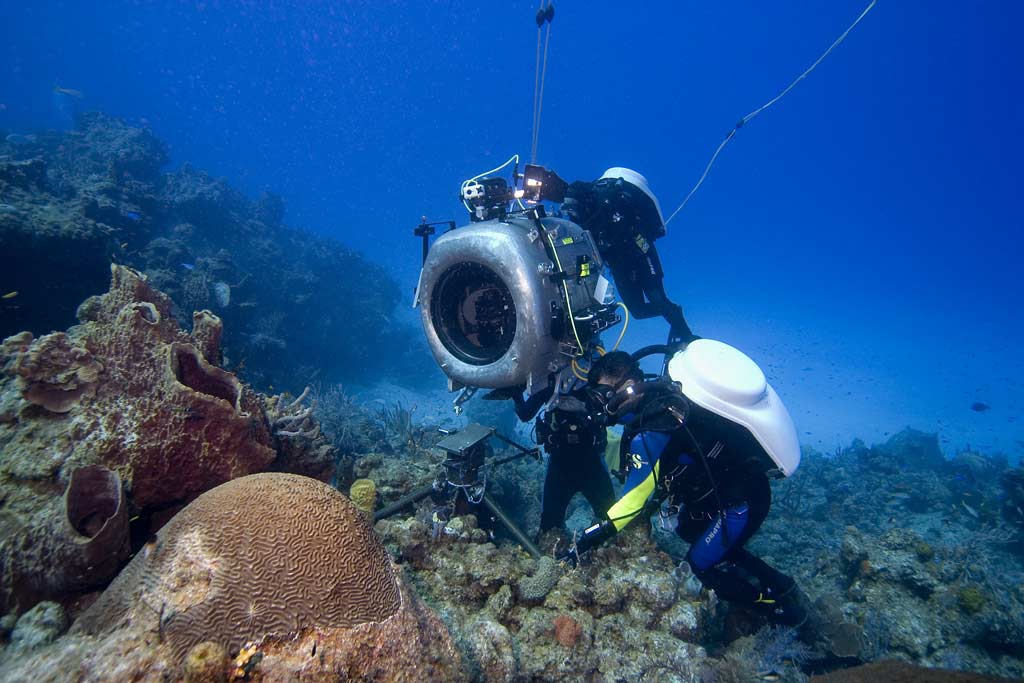
IMAX Under the Sea 3D
fisheye lenses, becomes IMAX SOLIDO Photo credit: Michele Hall |
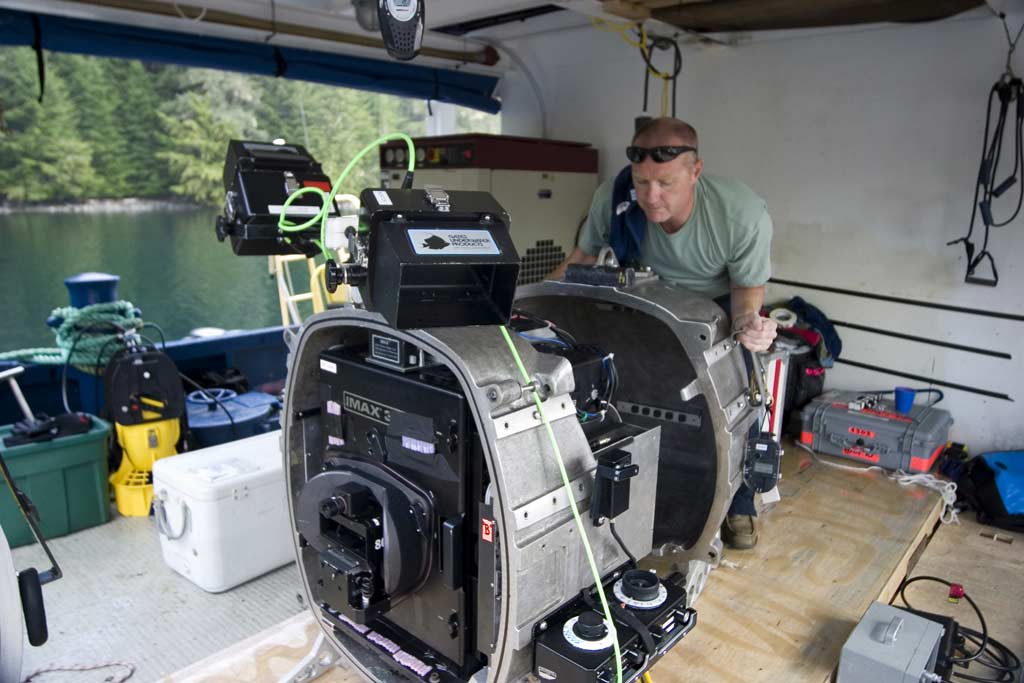
Howard Hall with the underwater IMAX 3D camera |
IMAX 3D camera with underwater housing removed |

Yet while IMAX were moving onwards and upwards in the area of large format 3D, the latter years of the 20th century saw the rapid development of a totally different technology, one that would eventually redefine the way films are made and presented.
For good or ill the Digital Revolution was coming.
The first tape-based home camcorders were regarded as something of an expensive novelty, but they soon began to come down in price, and by the time they had become ’palmcorders’, recording their digital images on tiny discs and hard-drives, the 8mm and 16mm home movie market had virtually expired, with only small, dedicated bands of enthusiasts seeking out dwindling stocks of Super 8 and Standard 8 film. In recent years, with the development of Digital Light Processing technology, most notably by Texas Instruments, the future of actual ‘film’ has been in some doubt – though, happily, the ‘film is dead’ lobby may have been a little premature in their speculation. The film versus digital argument continues to rage, with some major film makers, such as James Cameron and George Lucas, seeming to embrace digital technology as photographic medium equal to, or even surpassing, the quality of film. However, what is becoming apparent is that 70mm photography is in the process of being rediscovered as convenient and practical way of recording images of a quality far surpassing current digital capability – with the added bonus of allowing the extraction of high quality images in any other format, including high definition transfers for the latest Blu-Ray digital technology.
 |
Though many film afficionados can barely bring themselves to utter the ‘D’ word, digital technology has irrevocably transformed the cinema industry; combined with unprecedented advances in computer science, an avalanche of block-busting special effects movies have poured out of film studios around the world, from Star Wars in the seventies to the latest Indiana Jones epic of 2008. And while the narrative and visual aesthetics of many of these productions might be questionable – especially in the opinion of this writer – they have generated the cash returns – and investments - that have funded the restoration and release of classic movies that we had feared would be lost forever; those same classic movies that we unapologetic movie maniacs collect on DVD with such enthusiasm. It should also be mentioned that the techniques pioneered in films such as Jurassic Park (1993), Terminator 2 (1991) and even Toy Story (1995) and Shrek (2001) have subsequently been used to create the stunning 3D effects in IMAX films such as T-Rex – Back to the Cretaceous (1998); Encounter in the Third Dimension (1999); Misadventures in 3D (2003) and Alien Adventure (1999) which, currently, remain unsurpassed (my opinion) as examples of high quality 3D.
It hasn’t been all sunshine and roses, though, particularly in the area of film presentation in many multiplexes. The advances in digital sound technology seem to have leapt forward, bringing clearer (and often stupendously loud) surround sound to the multiplex auditoria - but with curiously subdued dialogue that we often strain to hear (well, I do), while just the opposite seems to be happening to the visuals with their grainy, shaky and under-lit images – digital or otherwise – that seem to be the current (hopefully brief) fashion; the Bourne films, anyone? The new Bond films, perhaps? And the worst culprit to date; The Assassination of Jesse James by the Coward Robert Ford (2008), a film which takes the once vibrant, Technicolor western to a new low of semi-sepia toned dullness.
However, despite my own personal obsessions about colour and light, the future for 3D in the cinema looks promising once again, thanks to digital technology. Digital projectors now being installed in screens throughout the world can project flat or stereoscopic movies with just the flick of a switch. 3D movies are starting to appear almost as regularly as they did in 1950s heyday – and even the new plastic glasses are cool (especially my green Chicken Little 3D [2005] ones).
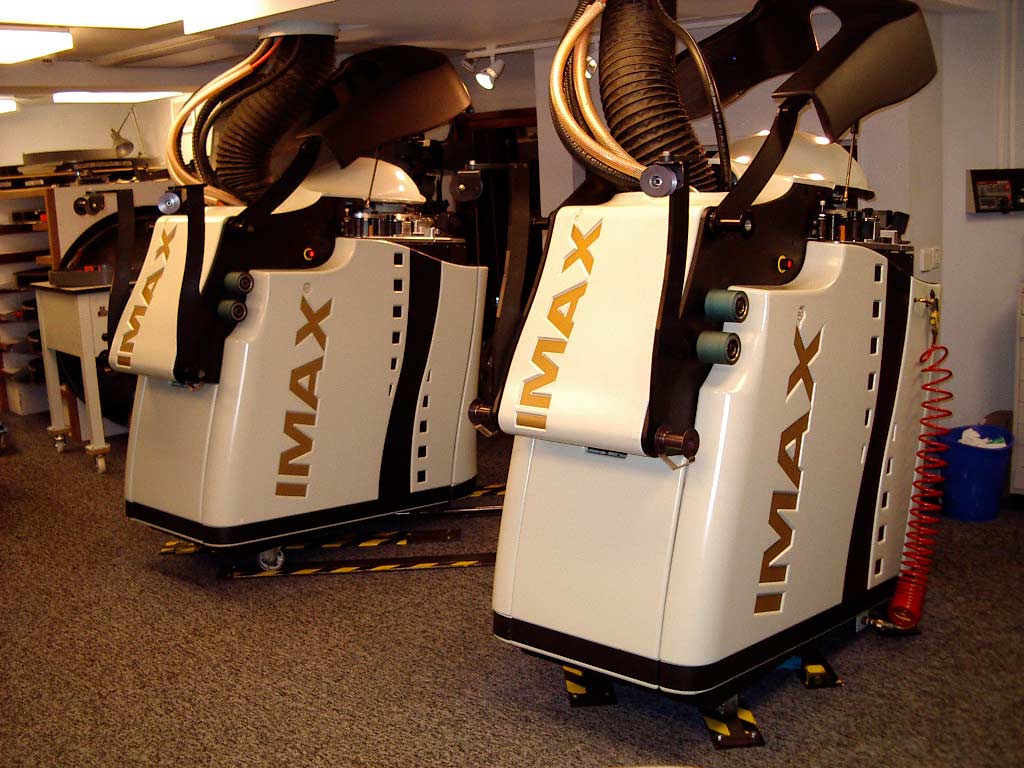
A pair of IMAX 3D projectors |
Note the angled track on the floor along which the |
Close shot of the IMAX 3D projector heads. |


I don’t believe that film will disappear anytime soon. It will remain a vital tool in the filmmakers’ toolbox for years to come as a means of originating a superior image – a pure IMAX film is a testimony to that - but the digital revolution has brought cinema technology into our homes, allowing us to enjoy our favourite films with a clarity unmatched since movies began. As for 3D, now that Cameron, Spielberg, Rodriguez, Zemeckis and Lucas (Ghosts of the Abyss (2003); Spy Kids 3D (2003); Shark Boy and Lava Girl 3D (2005); The Polar Express (2004); Beowulf (2007) and this year’s much-anticipated Avatar) have all voiced their enthusiasm – and more importantly put their collective financial muscle behind research and production, it is reasonably certain that this time – this time – 3D will be here to stay.
J.H.
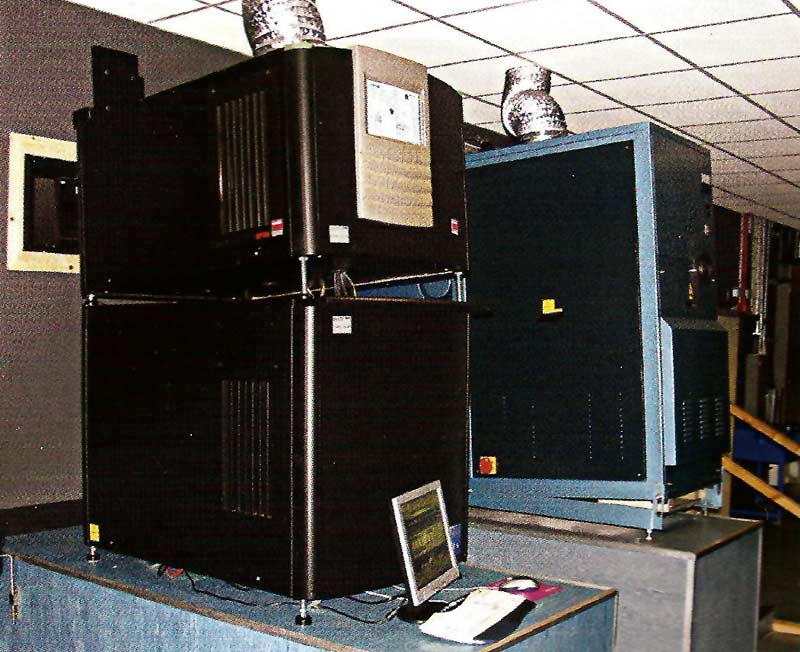
A typical digital projector, |
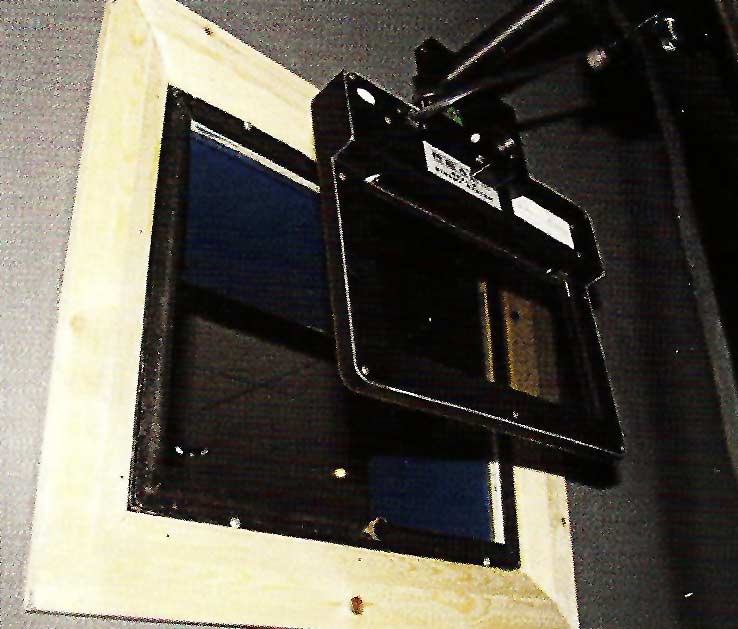
A polariser in front of the |
The Editor’s checklist of 3 things that 3D filmmakers STILL DO and SHOULDN’T!
In my life outside of these pages I’ve been an active stereo photographer for the last 25 years, so learning the do’s and don’ts of 3D imaging has been a long and painful process. I absolutely do NOT claim to be an expert, but really it’s just common sense: if it irritates your eyes, then something’s wrong.
KEEP EVERYTHING IN FOCUS - This is first, biggest and most often repeated mistake. If you are looking at something ten or twenty feet away, your eyes will automatically focus on that scene. If you then hold up your hand in front of your face, your eyes will refocus on that and the background will be then out of focus – blurred in other words. 3D filmmakers still persist in filming actors in close shots against a background full of objects that are out focus. In real life, if you glanced away from the actors to the background, your eyes (or to be more accurate, your brain) would readjust focus accordingly, but when the scene is recorded on film then the background is out of focus forever. Your brain – or that bit of it that works the eyes - doesn’t really know the difference between a 3D movie and real life, so unfortunately no amount of eye muscle flexing signals from it will let your eyes bring that background into focus. Result: EYESTRAIN! Please, please, please – if you must have a close up, shoot it against a neutral background, like a distant sky or something – anything that our eyes don’t need to focus on.
DON’T SHOOT IN THE DARK – Some directors love dark, gloomy scenes – that’s fine, but they usually achieve them by turning the lights off. Well, you know, you can’t actually perceive 3D in the dark. You need to be able see objects in various planes of depth for 3D to be effective. The worst example I ever saw was, surprisingly, Richard Fleischer’s Amytiville 3D (1983). Half the movie seemed to be in darkness – a waste of 3D. On the other hand, Ben Stassen’s 2001 IMAX 3D film, Haunted Castle (2001)–admittedly a computer animated film–managed to reproduce the dark and gloomy edifice of the title while still letting you see every detail of the scene. Subtle lighting, that’s the way to do it!
AVOID FAST MOVEMENT ACROSS THE SCREEN – This might seem a to be an odd complaint – but have you seen Robert Zemeckis’ Beowulf? Great movie – great cast (not sure about Ray Winstone’s cockney Beowulf, though) and great 3D, but characters whizzing about the IMAX screen and the repeated zip pans had me dizzy. Too much, too much! Let’s slow it down a little. Zemeckis got it dead right with the high speed thrill ride that was The Polar Express, but in that one the audience generally moved with the action. Objects coming out of the screen fast is okay, though. That’s the fun of 3D!
Agree? Disagree? Or can you think of even more tortures that 3D filmmakers inflict on us?
Let me know!-
and a final thought…
Now that we have all this digital technology at our disposal – or at least the studios do – and now that 3D is the The Next Big Thing, it should be possible to make high definition transfers of those rarely seen 3D classics from the 1950s. Just imagine, House of Wax; Kiss Me Kate; Dial M for Murder; Charge at Feather River; Inferno; Miss Sadie Thomson; It Came from Outer Space – there’s quite a long list, actually – all restored to pristine splendour; scratch free, stereo sound; perfect synch every time. It could be done, you know. And I know there would be a paying audience out there, at the very least curious, if not downright eager, to see these often talked about movies as they were meant to be seen. 3D revivals are always well attended, but they are far too rare, too poorly advertised and too far away for the average 3D fan to attend – and that’s just my own personal experience, living in the north of England.
So come on, you studio suits, go and unlock the vaults and dig out those treasures you’d forgotten you still have - and let’s have a real 3D revival!
2014 update: Some of our wishes have come true - House of Wax and Dial M for Murder are finally available on 3D Blu-ray, and other releases are planned. See the 3D Film Archive website for more information.
John Hayes